

Social media marketing can help businesses build trust, reach the right people, and turn attention into real leads. The challenge is choosing where to invest.
Meta and Google are both powerful advertising platforms, but they work in different ways. Meta is strong at creating demand through visual content and audience discovery, while Google is strong at capturing demand from people who are already searching.
The better choice depends on your goals, budget, offer, and customer journey.
How Meta Ads and Google Ads Differ in Social Media Marketing
Meta Ads appear across platforms such as Facebook and Instagram. They usually reach people based on:
- Interests
- Behaviors
- Demographics
- Previous interactions
This makes Meta useful when customers may not yet be actively searching for your product or service. A strong image, short video, or relatable message can introduce your business and create interest.
Google Ads works differently. Search campaigns place your offer in front of people who type specific queries into Google. These users often have clearer intent because they’re actively looking for an answer, product, or provider.
Google also offers:
- Display
- Video
- Shopping
- Other campaign formats
However, search intent remains one of its biggest strengths.
Think of Meta as a platform that helps people discover you. Google helps you appear when people are already looking.
Which Platform Offers Better Targeting and Customer Intent?

Meta gives businesses detailed audience-building options. You can target people based on:
- Age
- Location
- Interests
- Online behavior
- Engagement with your brand
It can be effective for lifestyle products, local services, events, hospitality, beauty, fitness, food, and other offers that benefit from visual storytelling.
Google focuses more heavily on keywords and search behavior. Someone searching for “emergency plumber near me” or “accounting firm for small business” is showing immediate intent. This can make Google especially useful for services that solve urgent or specific problems.
Neither targeting method is automatically better. Meta can reach people before they know they need you. Google can reach them when they’re closer to making a decision.
Your campaign should match where your audience is in the buying process.
Comparing Reach, Engagement, Leads, and Conversions
Meta often performs well for:
- Reach
- Video views
- Engagement
- Remarketing
- Lead generation
It gives businesses room to educate, entertain, and build familiarity before asking for a sale. Repeated exposure can increase trust, especially when the content answers questions, shows customer results, or demonstrates how a product works.
Google Ads often performs well for direct-response campaigns because users are actively searching. A well-matched ad and landing page can turn high-intent searches into calls, bookings, purchases, or inquiries.
Results still depend on execution. Meta won’t perform well if the creative is weak or the offer feels generic.
Google won’t perform well if the keywords are too broad, the ad copy is unclear, or the landing page doesn’t answer the searcher’s needs.
Reliable website development services can improve both platforms by creating fast, clear, and mobile-friendly landing pages. SEO services can support long-term visibility, while paid campaigns bring more immediate traffic. Working with a content marketing agency Philippines can also help businesses produce messages and visuals that feel relevant to their target audience.
Which Platform Is More Cost-Effective for Businesses?
Cost depends on the:
- Industry
- Competition
- Audience
- Location
- Campaign objective
- Quality of the offer
Meta may provide lower-cost reach and engagement, but low-cost clicks don’t always become customers. Google clicks can be more expensive, especially in competitive industries, but those visitors may have stronger buying intent.
The cheapest platform isn’t always the most profitable one. A campaign that generates ten low-quality leads may be less valuable than one that generates three strong leads who are ready to buy.
Businesses should compare:
- Cost per qualified lead
- Conversion rate
- Customer value
- Return on ad spend
These numbers give a clearer picture than impressions or clicks alone. It’s also important to give campaigns enough time and data before making major changes. Stopping too early can prevent the platform from identifying which audiences, keywords, and messages work best.
When to Use Meta, Google, or Both
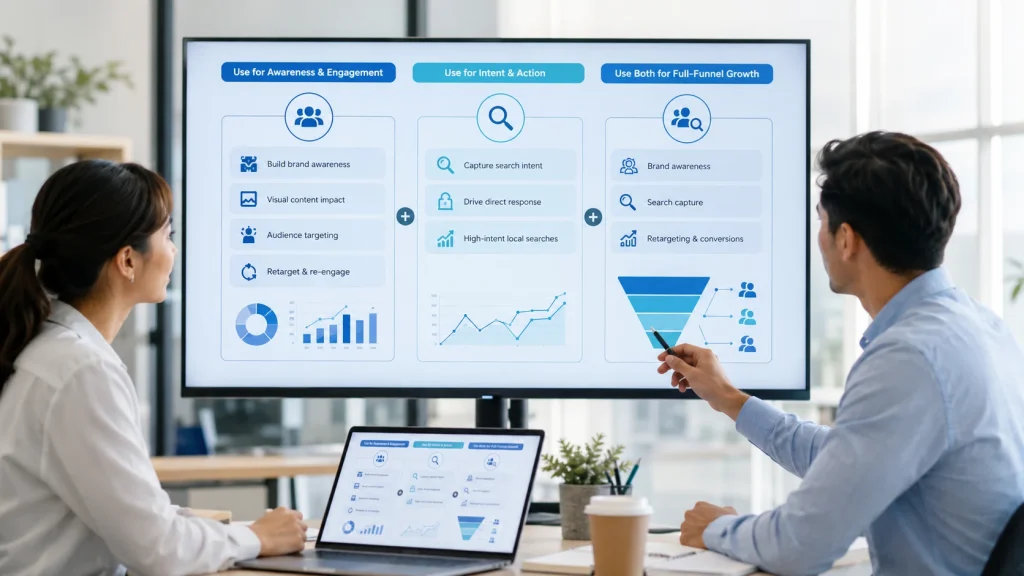
Choose Meta when your goal is to:
- Build awareness
- Create demand
- Promote visual content
- Retarget interested users
- Reach a clearly defined audience
It can be especially effective when customers need to see your brand several times before taking action.
Choose Google when your customers are:
- Already searching for your service
- Comparing providers
- Trying to solve an immediate problem
It’s often a strong option for high-intent local searches, professional services, repairs, bookings, and products with clear search demand.
For many businesses, the strongest approach is using both. Meta can introduce the brand and build familiarity. Google can capture people when they’re ready to search, compare, and act. Retargeting can then reconnect with visitors who didn’t convert the first time.
A combined strategy also gives you more useful data. Meta Ads can reveal which messages and visuals attract attention, while Google can show which search terms lead to inquiries or sales.
Choose the Platform That Matches Your Social Media Marketing Goals
Meta and Google don’t compete in exactly the same way, because they support different parts of the customer journey.
Meta is excellent for discovery, storytelling, engagement, and demand creation.
Google is excellent for search intent, direct response, and reaching people who already know what they need.
The right platform depends on your audience, goals, and customer journey. Tech Support Plus can help you build a strategy that connects the right ads, creative content, offer, and landing page to generate stronger results. Contact our team today to create a campaign that builds trust, reaches qualified customers, and turns clicks into valuable leads.