

Introduction
Have you ever thrown money at ads and gotten… nothing? Running ads without a plan is expensive. But with the right targeting, budget, and creative strategy, your ads can become powerful magnets that attract the right people, who care, engage, and convert.
Here “Meta ads online” refers to paid advertising on platforms owned by Meta (like Facebook and Instagram). These are not just random boosted posts. They’re strategic ads built to reach specific audiences, optimize spending, and deliver real results from awareness to conversions.
In this article, I’ll show you how to choose the right audience, budget wisely, and design ad creatives that convert.
Understand Your Ideal Audience: Targeting Strategy
Why Targeting Matters
Precise targeting is the difference between your ad being seen by people who could care and those who won’t. When you show your ad only to people likely to be interested, you reduce wasted spending and boost return on investment (ROI). A well-targeted ad means conversions, not just empty impressions.
If you cast a wide net without focus, many eyeballs may see your ad, but few will care. That’s why targeting matters: ads tailored to relevant audiences tend to perform better.
Audience Types: Core, Custom & Lookalike Audiences
To reach your ideal customers, you can choose among different audience types:
Core Audiences — based on demographics (age, gender), interests, behaviors, and location. This lets you target broadly but within a relevant scope (e.g., “young adults, fitness fans, living in Manila”).
Custom Audiences — these are people who already know you: past website visitors, email subscribers, previous buyers, or people who engaged with your content. Ads to them often yield better results because they already have some familiarity with your brand.
Lookalike Audiences — this is where you scale: Meta ads online finds new people similar to your best customers (based on behavior, demographics, etc.). It’s a powerful method when you want growth beyond your existing base.
Targeting Best Practices & Pitfalls to Avoid
- Start with a slightly broader audience when you’re unsure. This gives Meta’s delivery system room to learn and find who responds best. Overly narrow targeting too early can hurt performance.
- Avoid over-segmentation (too many tiny slices based on minute differences). That often limits reach and increases cost per result.
- Segment campaigns by funnel stage — e.g. cold traffic, warm audience, and retargeting. Mixing them together makes your results and budgeting unclear and blurs targeting effectiveness.
- Exclude irrelevant or already-converted users when appropriate. This reduces wasted spending.
Get Inspiration and Insights Using Meta Ads Library
Whenever you need fresh ideas or want to understand what successful brands are doing, the Meta Ads Library is your best friend. It’s a public database where you can browse real ads running across Facebook and Instagram, so you can spot trends, study winning creatives, and see how competitors communicate with their audience. It’s like having a behind-the-scenes peek at what works, which is super helpful when planning your next campaign or refining your ad strategy.
Budget Smart: How to Plan & Allocate Your Ad Spend
Types of Budgets: Daily vs Lifetime
When you launch ads, you’ll often choose between a daily budget or a lifetime budget.
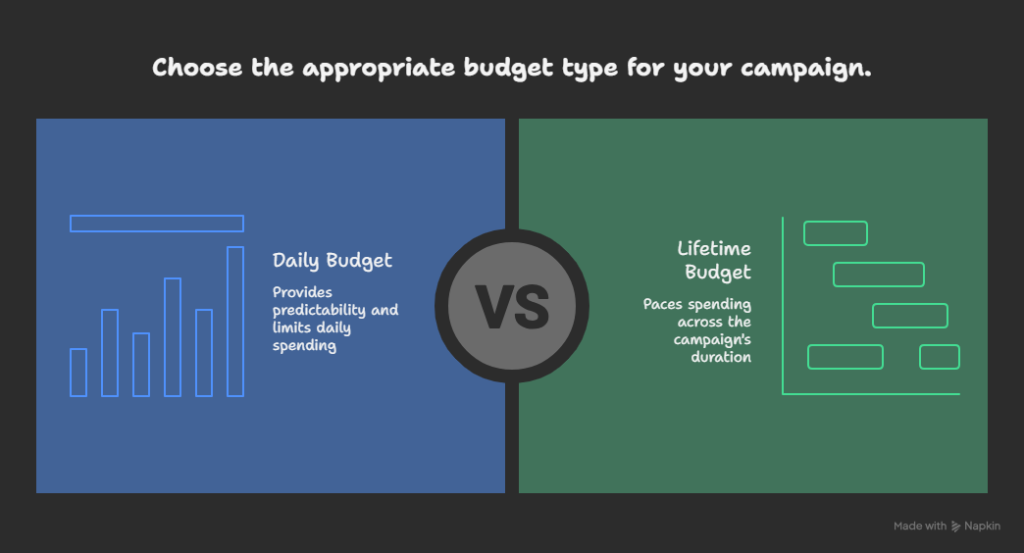
If you’re just testing an audience or creative, a small daily budget is often a good starting point. It limits risk while you learn what works. Many advertisers begin with minimal spending while exploring different variables.
Budget Allocation & Scaling Strategy
- Begin with a modest budget allocated to a few ad sets to test different audiences or creative variants. This helps you learn what works without overspending.
- When you identify winning ad sets (audience + creative combinations that convert), scale gradually — for example, increase budget by 20–30% every few days so you don’t disrupt the ad delivery algorithm. Sudden large increases may reset performance learning.
- Avoid spreading your budget too thin across too many ad sets. Instead, consolidate your spending into fewer, well-performing ad sets to give the algorithm enough data and momentum.
Link Budget to Campaign Objective & Funnel Stage
- For upper-funnel goals (awareness, reach): target broader audiences, and use a lighter budget per user.
- For lower-funnel goals (consideration, conversion, remarketing): narrower audiences, often with higher budgets per user—because these people are closer to decision-making.
- Always track performance metrics (e.g., cost per click, conversions, cost per result) to know when to scale, pause, or reallocate budget. Data-driven decision-making helps avoid overspending and improves ROI.
Crafting Creatives That Convert: Design & Copy Tips
Match Creative to Audience & Offer
Your ad creative—visuals and copy—must speak to the needs, interests, and context of your target audience. If your audience loves stylish minimalism, don’t show cluttered, chaotic ads. If they care about value, highlight clear benefits.
Strong creatives align the offer, value proposition, and audience. When visuals and messaging resonate with viewers, click-through and conversion rates go up.
Use Best Practices for Visuals & Formats
- Use high-quality images or short videos. Ads with crisp visuals or engaging video hooks tend to perform better. For video, hooking attention in the first 1–3 seconds is crucial.
- Make sure visuals follow the correct aspect ratio and format, depending on placement (feed, stories, etc.). A design that looks good on a mobile feed might not work on stories—adapt accordingly.
- Keep text short, clear, and benefit-oriented. Avoid clutter. Use a strong call-to-action (CTA) that invites a direct response (“Shop now,” “Learn more,” “Sign up”).
- Keep branding consistent: colors, fonts, and tone. Consistency builds trust and recognizability.
Test & Optimize Creatives Continuously
- Run A/B tests—different images, headlines, CTAs, and formats. See which ones get better engagement and conversion. Don’t put all your eggs in one creative.
- Pause or drop creatives that underperform. Allocate more budget to winners. This avoids wasting resources on ads that don’t work.
- Rotate creatives regularly to avoid “ad fatigue.” Over time, the same creative may lose its effectiveness. Refresh visuals, copy, or format to keep the audience engaged.
Putting It All Together: Sample Workflow/Checklist
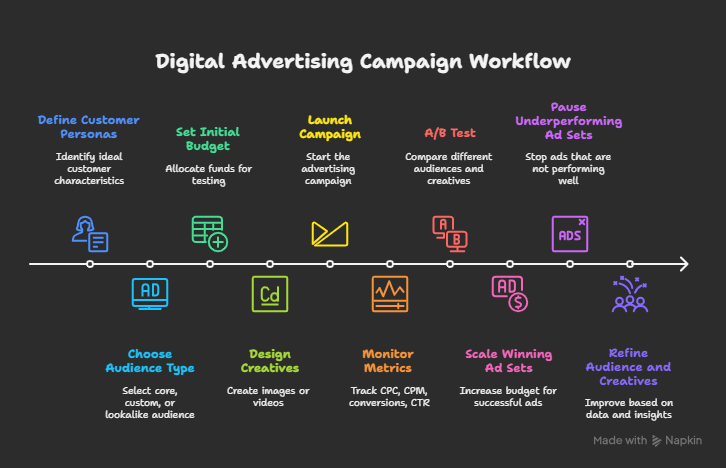
Use this checklist as your go-to blueprint before launching any ad campaign.
Common Mistakes & How to Avoid Them
Mistake: Targeting too narrowly too soon → often results in high cost per result.
Fix: Start broad, let the platform optimize, then narrow down once you have performance data.
Mistake: Spreading budget too thin across too many ad sets.
Fix: Consolidate budget into fewer, stronger ad sets so each gets enough delivery and data to perform well.
Mistake: Relying on visuals alone—ignoring copy, offering clarity, or funneling logic.
Fix: Ensure ad copy, creative, CTA, and offer align with your audience’s mindset and funnel stage.
Mistake: Not testing enough variations before scaling.
Fix: Run multiple creatives and audiences, test properly, and only scale what works.
Using Meta Business Suite Promotion to Boost Your Ad Strategy
If you want to make your campaigns even smoother, try managing everything inside the Meta Business Suite promotion. It gives you a simple dashboard to track results, tweak targeting, edit creatives, and adjust budgets without juggling multiple tabs. Think of it as your all-in-one control center, perfect for staying organized, spotting what works, and making quick improvements so your Meta ads online keep getting better over time.
Conclusion & Next Steps
Effective Meta ads online don’t happen by accident. Great campaigns rely on three key pillars: the right audience (targeting), smart budgeting, and creative that converts.
If you treat each ad campaign as an experiment, define your audience, allocate budget wisely, design with purpose, test, and learn, you’ll get better results over time. Start small, watch the data, and scale strategically.
Use this article as a checklist and framework before launching your next Meta ads online campaign. Plan carefully, design thoughtfully, test relentlessly, and watch your ads attract the audience you really want.