

Introduction
Is your backup investment truly delivering value? Many business owners focus on buying the tools, signing the contract, and then moving on to the next project.
But with cloud backup solutions for business, the question you should ask is, “How do you measure the value you’re getting?”
Businesses invest in these solutions to ensure business continuity and protect data from loss, whether due to hardware failure, human error, cyberattack, or something unexpected.
In today’s landscape the move to cloud computing and advanced cloud solutions has enabled new backup models that are scalable, flexible, and far more dynamic than traditional on-premises systems.
With that in mind, let’s explore how you can measure ROI (return on investment) from your backup strategy and show that the investment is worth it.
Define ROI in the context of backup
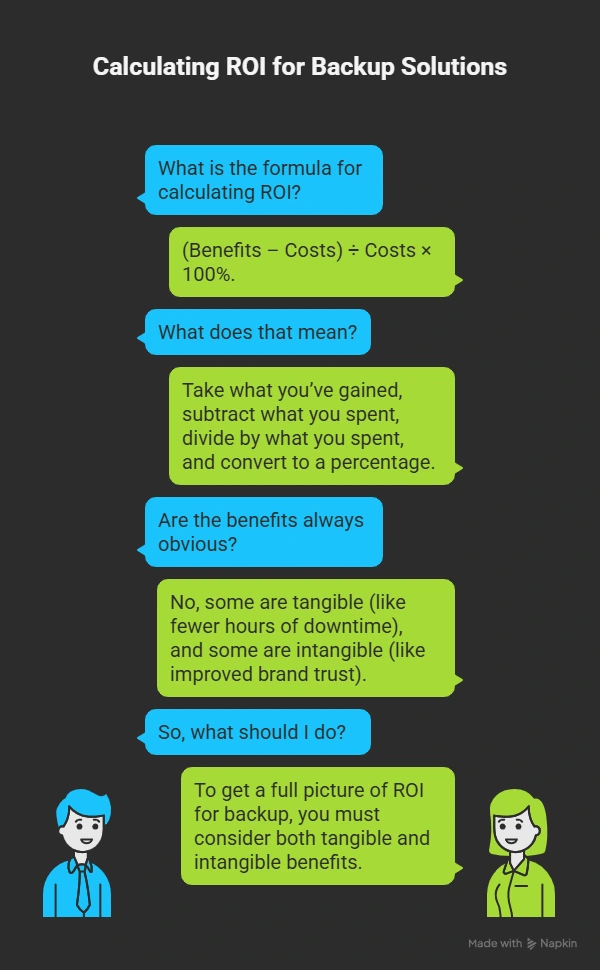
So what exactly is “ROI”? In simple terms, it’s the return you get compared to what you invest. The basic formula is
Identify costs associated with cloud backup
Before you can gauge return, you have to know what you invested. For cloud backup solutions for business, costs typically fall into three categories:
Up-front investment
Subscription or license fees
Migration costs (moving data, configuring systems)
Implementation: setting policies, training staff, initial setup
Ongoing operating costs
Monitoring, maintenance
Storage fees (especially if data grows)
Bandwidth and network costs
Staff time: managing the system, testing restores
Hidden or indirect costs
Training new hires or existing staff on the backup system
Data-egress fees (moving data out of cloud)
Compliance overhead (audit, reporting)
Potential performance or latency costs if improperly sized
By putting these cost categories on the table, you set a baseline for measuring ROI. Without understanding “what you spent,” you can’t accurately evaluate “what you gained.”
Identify measurable benefits
Now let’s flip to the gains, what you’re getting in return for your investment in backup solutions. Some of the most powerful benefits include:
Reduced downtime
When systems go down or data is lost, the fewer hours your business is offline means direct savings and less impact on revenue and productivity.
Avoided data loss or breach costs
These can include regulatory fines, lost business, reputational damage, and recovery expenses. For example, one study showed a 78% return on investment from dedicated backup because of avoided losses.
Efficiency gains
Your IT staff spends less time on manual backups, has fewer duplicate tools, and has faster recovery, which means less cost and more time for strategic work.
Scalability/flexibility
With a cloud-based approach, you avoid over-provisioning hardware, you scale as you grow, and you pay for what you use. This means lower waste.
Intangible but real value
Things like brand trust, faster innovation, and competitive agility are harder to put a number on but still part of the return.
Choose the right metrics and KPIs
To make ROI meaningful and actionable, you’ll need measurable metrics and key performance indicators (KPIs) that tie your backup investment directly to business outcomes, not just IT stats. Here are some vital ones:
Recovery Time Objective (RTO) and Recovery Point Objective (RPO)
The faster you recover, the lower your cost of disruption.
Number of downtime incidents per year and average cost per incident
Helps quantify what you’ve saved.
Staff hours saved × hourly cost
E.g., if backup automation saves 200 hours a year, what is that worth?
Infrastructure cost reduction
Compare on-premises hardware cost vs. cloud backup cost.
Customer churn, or lost revenue, is avoided thanks to better continuity
If your service stays up when others go down, you retain customers.
Tracking these kinds of metrics helps you articulate backup as a business outcome, not just an IT checkbox.
Perform the ROI calculation
To bring it all together, you’ll perform a calculation. Here’s a simple example:
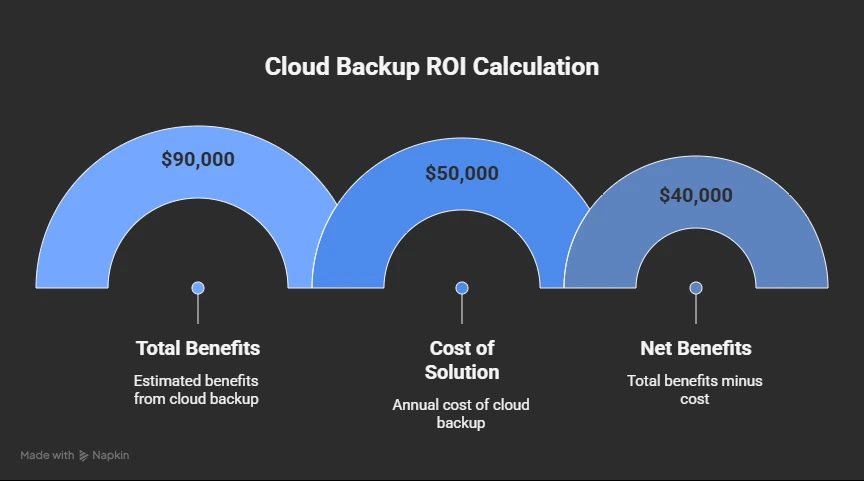
You’ll want to emphasize consistency: make sure costs and benefits cover the same period; avoid mixing apples and oranges. Also note that ROI might look different in year 1 vs. year 3 because up-front migration costs may dominate early on.
Finally, perform a sensitivity analysis: what if benefits are lower or costs higher? This helps you understand risk and set realistic expectations.
Consider challenges & pitfalls
Even a well-planned cloud backup solutions for business investment can fail to show expected ROI if you fall into these common traps:
Difficulty in quantifying intangible benefits (brand, innovation) or hidden costs means you may undervalue or misvalue parts of the equation.
Overlooking ongoing costs such as training, staff turnover, compliance, and data growth costs.
Using a biased baseline: if your “before” backup cost or downtime data is incomplete/inaccurate, the “after” benefit may be inflated.
Failing to reassess ROI periodically: what looked good in year one may change as your business grows, data volume increases, or the threat environment evolves.
Best practices to maximize your backup ROI
To get the most out of your investment in cloud backup solutions for business, here are some best practices:
Define clear baseline metrics before you implement (current downtime costs, staff hours, and infrastructure costs).
Use instrumentation and dashboards for ongoing measurement so you can track real performance.
Align your backup strategy with business goals (not just IT goals). Example: if your business goal is 99.9% uptime, back it with appropriate backup KPIs.
Right-size your solution: don’t overpay for capacity you won’t use or features you don’t need.
Review and adjust every 6-12 months: revisit assumptions, actuals, data growth, and the threat landscape.
Communicate results to leadership in business language: cost avoided, revenue protected, not just “we backed up X TB of data.”
Conclusion
Measuring ROI from your cloud backup solutions for business isn’t just possible; it’s essential. You’re not just buying storage; you’re buying resilience, continuity, and peace of mind.
By taking a structured approach, defining what you spent, quantifying what you gained, choosing the right metrics, calculating ROI, and monitoring over time, you can prove the value of your investment and make better decisions.
Now is the time to take action: start measuring today so you can confidently demonstrate that your backup investment is paying off tomorrow.