
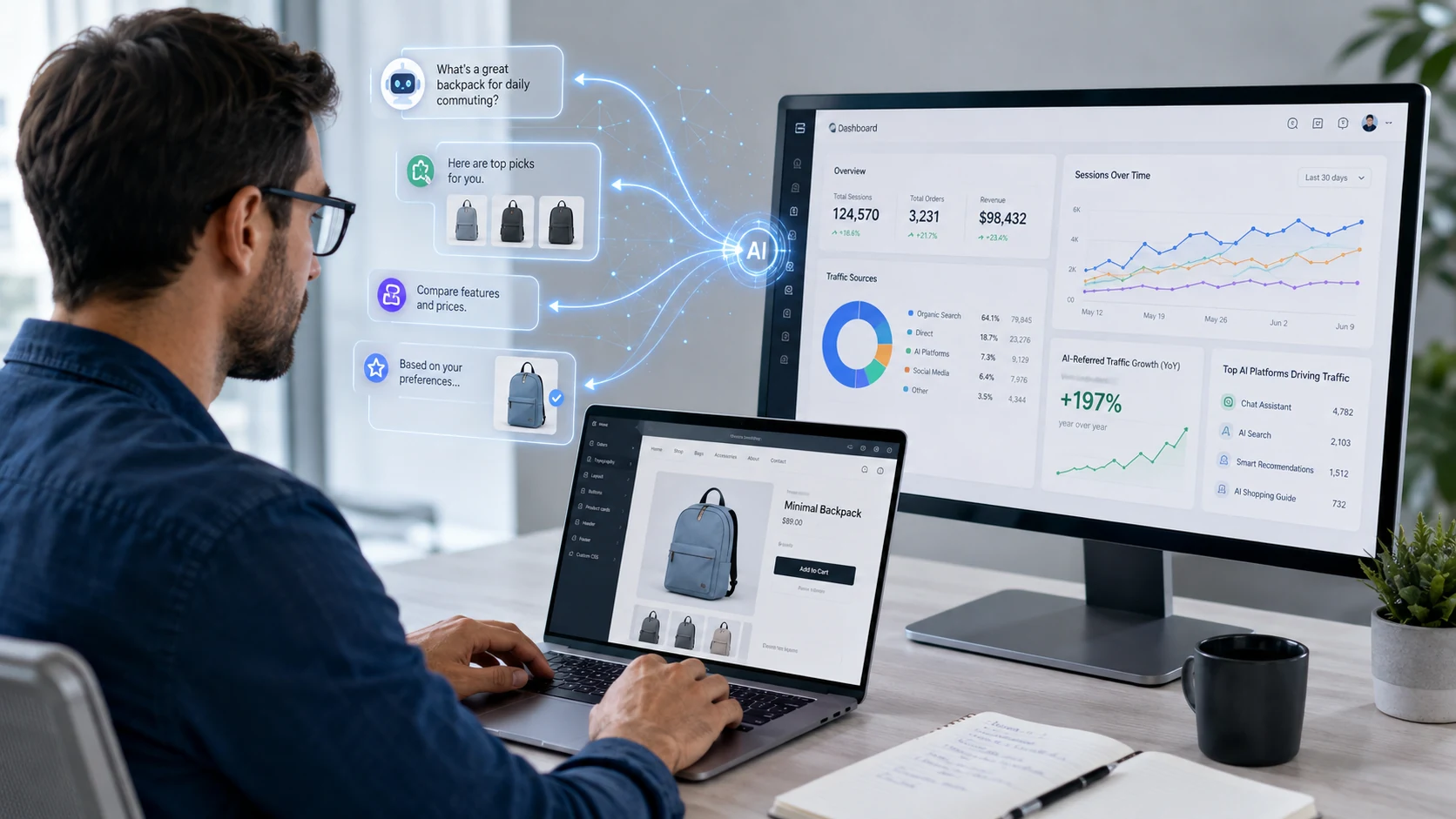
Your Shopify store may be getting visitors from places you weren’t paying much attention to a year ago. Customers aren’t only discovering products through Google, social media, or paid ads anymore. AI platforms are starting to send shoppers directly to online stores too.
That creates a new challenge for Shopify web development. A store now needs to work for traditional search, real customers, and increasingly, AI systems trying to understand products and recommend them.
Recent Shopify data showed that AI-referred sessions to merchant storefronts increased 197% year over year, while organic search traffic still grew and remained the larger traffic source.
The message isn’t that Google suddenly matters less. It’s that Shopify merchants may now have another important discovery channel to prepare for.
Shopify Web Development Is Facing a New Source of Traffic
AI referrals aren’t just another number to add to an analytics report.
Shopify’s data showed that AI-referred sessions and orders grew significantly across many product categories. In some research-heavy categories, shoppers arriving through AI also showed stronger conversion behavior.
That matters for Shopify web development because AI systems need clear, useful information before they can confidently surface a product.
A good-looking store still matters, but appearance alone isn’t enough. Product information, categories, navigation, specifications, and other details need to be easy to understand.
If important information is buried or inconsistent, both shoppers and AI systems may have a harder time figuring out what the store actually offers.
AI Is Starting to Send More Shoppers to Online Stores
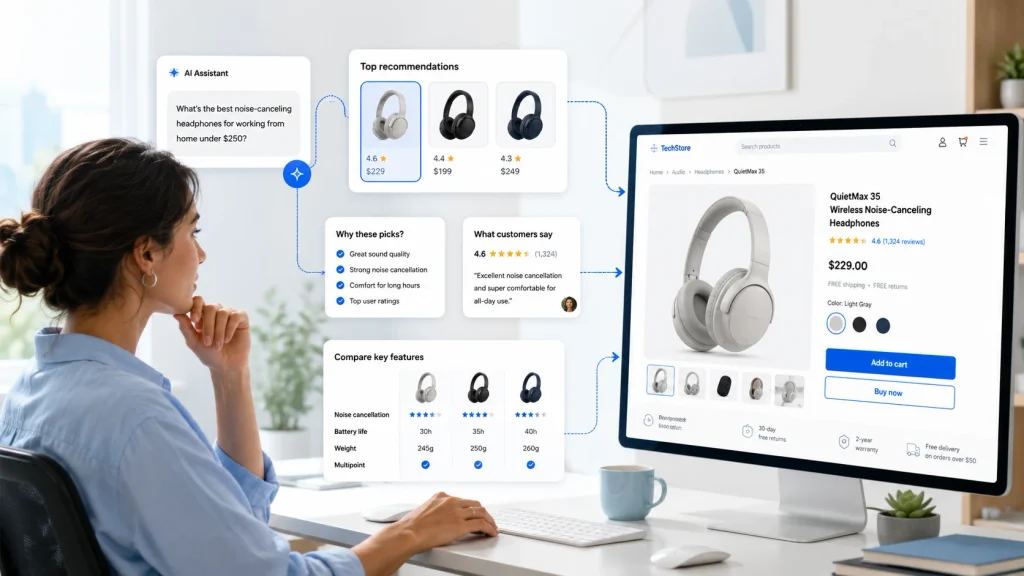
Think about how online shopping normally works.
A customer searches for something, opens several stores, compares products, checks reviews, and eventually decides where to buy.
AI search can shorten parts of that journey.
Someone might ask an AI assistant for a specific product based on price, features, compatibility, or personal preferences. The AI can help narrow the options before the shopper ever reaches a store.
Shopify’s findings also suggest that AI referrals can bring new customers, which makes this more than a visibility issue.
For Shopify e-commerce, AI could become another layer between a customer’s original question and the store they eventually visit.
The challenge is making sure your products provide enough useful and accurate information to earn a place in that journey.
What AI Traffic Means for Shopify Website Development
This doesn’t mean businesses need to rebuild their stores specifically for AI.
Good Shopify website development still starts with the fundamentals: clear pages, useful information, fast performance, easy navigation, and a smooth mobile experience.
What may change is the importance of how information is organized behind the scenes.
Product names, descriptions, categories, availability, specifications, and other structured details can help digital systems understand what a store sells.
That’s why web development services shouldn’t focus only on how the website looks when it launches. A strong store also needs a structure that supports discovery, updates, and future changes in how customers find products.
Tech Support Plus IT Services takes this wider approach when improving e-commerce websites, connecting design and functionality with the way people actually search and shop.
Shopify Web Development Needs Clear Store Structure
A confusing online store already creates problems for customers.
AI simply gives businesses another reason to fix them.
Products buried under unclear collections are harder to discover. Thin descriptions provide little context. Poor navigation makes browsing frustrating. Slow mobile pages can lose customers before they even consider buying.
Strong Shopify web development should pay attention to:
- Clear product and collection organization
- Useful product descriptions
- Logical navigation
- Descriptive headings
- Internal links between relevant pages
- Accurate product information
- Fast mobile performance
These aren’t completely new requirements. They’re good ecommerce practices that become even more valuable as discovery expands beyond traditional search results.
SEO and Branding Still Matter as Shopping Behavior Changes

A large increase in AI referrals sounds exciting, but traditional search is still responsible for a major share of Shopify traffic.
That means abandoning Shopify SEO to chase the newest channel would be a mistake.
Strong organic search traffic still gives stores an important source of visibility. Clear pages, helpful content, accurate product information, and strong site organization can support both traditional search and newer AI-driven discovery.
Branding also remains important.
AI may recommend the product, but the customer still needs to trust the business selling it. This is where the effects of branding techniques and marketing strategies become visible through consistent messaging, useful content, recognizable presentation, and a smooth buying experience.
The same applies to the best SEO practices for blog posts. Helpful articles can answer questions before customers are ready to buy and give both search engines and visitors more context about the business.
What Shopify Stores Should Start Preparing for Next
AI traffic doesn’t mean Shopify merchants need to panic or completely change direction.
It means discovery is becoming more diverse.
Traditional search, social platforms, paid campaigns, and AI recommendations can all introduce customers to the same store at different points in their journey.
Businesses should focus on building stores that can handle that variety.
Keep product information accurate. Make navigation simple. Improve mobile usability. Maintain SEO fundamentals. Give customers enough information to make confident decisions.
Tech Support Plus IT Services can help businesses improve Shopify stores with stronger structure, performance, search visibility, and customer experience.
If your store needs to perform across traditional search, AI discovery, and everything in between, contact Tech Support Plus IT Services and build a Shopify experience ready for how customers are finding products next.