

Introduction
Is Your Brand Ready to Join the Conversation in AI-Driven Search? Not too long ago, you would type a question into Google, browse through a list of blue links, and click the one that looked most promising.
Today, you are just as likely to get a full, conversational response from an AI agent that summarizes everything you need to know without you ever having to leave the search page. This is the new reality of the internet. AI is fundamentally transforming how people find answers, moving away from a library-style index and toward a personal assistant experience.
If you are a business owner or a marketer in the Philippines, you might be wondering if your current digital strategy is enough to survive this shift. While traditional search methods are not disappearing, they are certainly evolving. We are moving into a phase where simply being on the first page of Google is no longer the ultimate goal.
The real prize is being the source that the AI cites when it generates an answer for a user. This transition from SEO to GEO is the most important shift in digital marketing this year, and understanding it is the key to staying visible in a world dominated by generative engines.
This shift matters because it changes the definition of visibility. In the past, you wanted to be seen. Now, you want to be referenced. Whether you are a local restaurant in Makati or a nationwide e-commerce platform, your brand needs to be part of the AI’s internal knowledge base. If the AI does not know you exist or cannot verify your information, you are effectively invisible to a huge portion of your target audience.
What is Changing in Search Behavior
We are witnessing a massive move from list-style results to AI-generated answers. Think about the last time you searched for a complex topic, like how to register a business in the Philippines or the best way to cook a perfect sinigang. Instead of clicking through three different blogs to piece together the answer, Google’s AI Overview or a tool like Perplexity likely gave you a step-by-step guide right at the top of your screen.
This is often called a zero-click search. It means the user gets their answer immediately and never clicks on a website link. For many website owners, this sounds like a nightmare, but it is actually an opportunity. If the AI mentions your brand as the expert source for that information, your credibility sky-rockets. Traditional SEO still provides the foundation for this because you still need to be indexable and fast, but it is not enough on its own anymore. You need to optimize for the engine that creates the answer, not just the engine that sorts the links.
For example, a user might ask, “What are the requirements for a home loan in the Philippines?” Instead of showing a list of bank websites, the AI will synthesize the common requirements, interest rates, and processing times into one cohesive paragraph. If your bank’s website is the one the AI trusts to pull that data from, you have won the most valuable real estate on the internet. This is the heart of the SEO to GEO strategy.
Understanding AI Search and Its Impact
Generative models do not just “look up” words. They use multiple sources to respond to a prompt by predicting the most helpful information. They are trained on vast amounts of data, and they look for patterns, entities, and context. When an AI generates an answer, visibility looks like citations, recommendations, and direct answers. You are no longer just a link in a list; you are a partner in a conversation.
This brings us to the emerging need to optimize for entity visibility and context relevance. In the world of AI search, your brand is an entity. The AI needs to understand what you do, who you serve, and why you are an authority in your niche. If you sell organic coffee in Benguet, the AI needs to associate your brand name with terms like “sustainable farming,” “local coffee,” and “high-quality beans.” The more the AI understands the context surrounding your brand, the more likely it is to recommend you when someone asks for the best local coffee brands.
| Feature | Traditional SEO | Generative Engine Optimization (GEO) |
| Primary Goal | Ranking in the top 10 blue links | Being cited in an AI-generated answer |
| User Interaction | Clicking a link to visit a site | Reading a summary or a conversational response |
| Content Focus | Keywords and backlinks | Entities, context, and direct answers |
| Success Metric | Click-through rate (CTR) | Brand mentions and citation frequency |
Core Principles of Getting Noticed by AI Engines
To win in this new environment, you have to play by a slightly different set of rules. The first principle is Clarity & authority. AI models prefer content that is easy to digest and obviously written by someone who knows what they are talking about. If your writing is vague or full of filler, the AI will struggle to extract the facts it needs to build an answer.
Secondly, Structure matters more than ever. AI engines are essentially high-speed reading machines. They look for headings, bullet points, and metadata to help them understand the hierarchy of your information. If your page is a messy wall of text, the AI will likely skip it in favor of a competitor who uses clear headings and logical sections.
Finally, you must provide strong Trust signals. This includes things like expert quotes, links to reputable sources, and clear references to your credentials. In the Philippines, where word-of-mouth and reputation are everything, these signals act as the digital version of a personal recommendation. If a reputable news site or an industry leader mentions your work, the AI notices that “vote of confidence” and increases your authority score.
Actionable Tactics to Apply
Transitioning your strategy from SEO to GEO requires a hands-on approach. Here are three major areas where you can start making changes today.
Optimize On-Page for AI Readability
You need to make sure your website is technically friendly for AI crawlers. This means using clean, semantic HTML and predictable formats. Use header tags (H1, H2, H3) correctly to outline your content. One of the best things you can do is include an FAQ section at the end of your articles. Provide short, definitive answers to common questions. For instance, if you write about travel, include a section that asks, “When is the best time to visit Siargao?” and answer it in two clear sentences. This makes it incredibly easy for an AI to pull your answer and give you the credit.
Strengthen E-E-A-T Signals
Google and other AI engines use E-E-A-T (Experience, Expertise, Authoritativeness, and Trust) to judge the quality of content. You can Strengthen E-E-A-T Signals by ensuring every piece of content has a clear author bio that lists real-world credentials. Use structured data (schema markup) to tell the search engine exactly who you are and what you do. Don’t forget to use descriptive alt text for your images. If you are an expert in Filipino finance, show it. Link to your LinkedIn profile, mention your years of experience, and quote other local experts to show you are part of a trusted community.
Adapt Your Measurement Metrics
If you only look at clicks, you are going to be disappointed because the world is moving toward zero-click results. You must Adapt Your Measurement Metrics to reflect the current landscape. Start tracking how often your brand is mentioned in AI Overviews or mentioned by chatbots like Gemini. Look at your conversion rates rather than just your traffic. Often, a user who reads an AI summary and then searches for your brand specifically is much closer to making a purchase than someone who just clicked a random link. Sentiment analysis is also becoming vital. Is the AI talking about you in a positive or negative way?
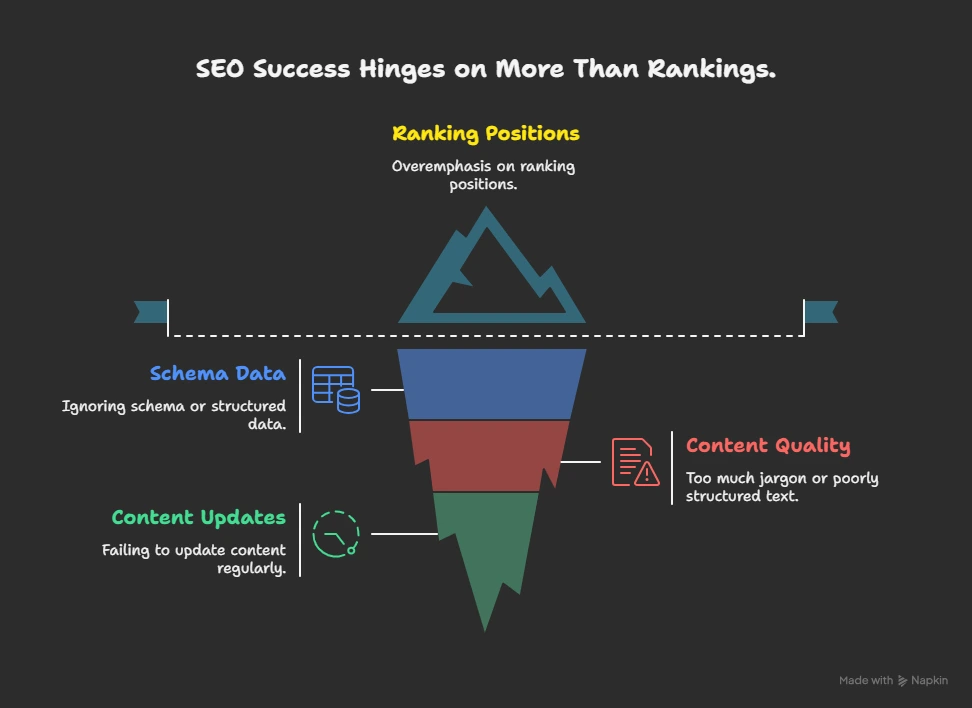
Common Mistakes to Avoid
As you move from SEO to GEO, avoid these common pitfalls that can hurt your visibility.
- Overemphasis on ranking positions only: Being number one on a search page is great, but if the AI answer above you gives the user everything they need, your ranking doesn’t matter as much. Focus on being the source for that answer instead.
- Ignoring schema or structured data: This is the language that AI speaks. If you don’t use schema markup to define your products, reviews, and events, you are making the AI work too hard to understand you.
- Too much jargon or poorly structured text: If a human can’t understand your point in thirty seconds, an AI probably won’t summarize it correctly. Keep your language simple, direct, and conversational.
Failing to update content: AI models love fresh data. If your information is three years old, it will be replaced by a competitor who updated their stats last month.
How to Blend Traditional and Future-Focused Strategies
You do not have to abandon classic SEO to succeed in this new era. In fact, traditional SEO is the bridge that gets you to AI visibility. The relationship between SEO to GEO is complementary. You still need a fast-loading website, mobile-friendly design, and a solid keyword strategy. These elements help search engines discover your site in the first place.
However, you must expand your efforts into AI visibility by focusing on authoritative backlinks and cross-platform content distribution. If your brand is mentioned on Reddit, YouTube, and local Philippine news sites like Rappler or Philstar, AI engines will see those mentions as proof that you are a relevant entity. Don’t just post on your blog and hope for the best. Share your insights across social media and participate in industry forums. The more places your brand “lives” online, the more data points the AI has to connect back to you.
Conclusion and Next Steps
The search landscape is shifting, but it is not something to fear. Succeeding in the transition from SEO to GEO simply requires a change in mindset. Today’s search environment requires both traditional discoverability and active inclusion in AI-generated answers. By focusing on structure, authority, and trust, you can ensure that your brand remains at the forefront of the conversation.
Remember that the goal is no longer just to get a click, but to be the definitive answer. Start by auditing your most important pages and asking yourself if an AI could easily summarize them. If the answer is no, it is time to restructure. Keep testing, measuring your brand sentiment, and leaning into structured content practices. The future of search is conversational, and your brand deserves to be heard.